
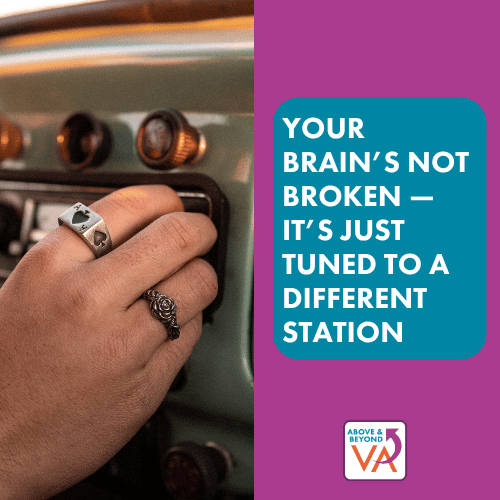
Right, let’s clear something up straight away.
If you’ve spent your whole life feeling like everyone else got issued a manual on “how to be normal” and yours never turned up, I need you to hear this: your brain isn’t broken. It’s not faulty. It’s not in need of fixing.
It’s just tuned to a different station.
Society’s been trying to get everyone listening to the same three chords on repeat for centuries, and if your brain naturally picks up different frequencies — if you think sideways, feel things louder, get bored stiff by stuff that’s “supposed” to interest you, or thrive on chaos that would send other people running for a paper bag — you’ve probably spent years being told there’s something wrong with the signal.
There isn’t. There never was. As I say in my book Sing Like No-One’s Listening!: “I definitely don’t ‘fit in’ and, if I’m honest, never did.”
And do you know what? I’ve made peace with that. You can too.
Meet the Band in Your Head
Also, in my book, I talk about a little imaginary band called F.D.I. — Fear, Doubt and Imposter Syndrome.
Three miserable so-and-sos who love nothing more than playing a gloomy little number on loop whenever you try to do something brave, different, or a bit outside your comfort zone.
Now, this band tours everywhere — they’re not exclusive to neurodivergent brains by any stretch.
But if you’ve spent years masking, overcompensating, or being told (subtly or not so subtly) that your natural way of thinking is “too much” or “not enough,” chances are F.D.I. have got a permanent residency in your head, and they’re playing to a packed house most days.
The good news? You don’t have to give them a standing ovation. You can acknowledge they’re there, turn the volume down and crack on anyway.
Why Western Society Plays the Same Three Chords
Here’s what nobody tells you growing up: the rules — the proper, traditional, “this is how it’s done” rules — weren’t written with neurodivergent minds in mind. Not even close.
School, careers, social norms, the whole shebang — it’s all built on one standard tuning, and if your brain doesn’t naturally play in that key, you’re left feeling “weird” or “wrong” for something that was never actually your fault.
I don’t think I have ADHD, but I might be on the spectrum — I genuinely don’t know, and at my age I’m not sure it matters all that much.
What I do know is I never fitted neatly into the traditional pathway. O-levels, A-levels, uni — that whole well-trodden path just wasn’t built for how my brain works, and trying to force myself down it nearly did me in.
It wasn’t until I stepped off it — found my own rhythm, did things my own way — that life actually started to make sense.
If that sounds familiar, you’re not broken either. You’ve just been playing on the wrong stage.
Reframing the Static: Imposter Syndrome as a Sign of Growth
Here’s a reframe that genuinely changed things for me: imposter syndrome isn’t proof you don’t belong. More often than not, it’s proof you’re growing. Stretching past your comfort zone. Doing something your nervous system isn’t quite used to yet.
A couple of quick, practical things that help quiet that static:
First, notice your language. Swap “I should” and “I must” for “I’d like to” and “I’m going to try.” Sounds small, but it shifts the whole tone of how you talk to yourself — less drill sergeant, more supportive mate.
Second, write yourself a proper professional mantra. A few honest lines about what you’re actually capable of, what you bring to the table, what you’ve already proven you can do.
Keep it somewhere you’ll actually see it — because on the days F.D.I. are playing loud, you’ll need the reminder.
Your Quirks Are the Melody, Not the Noise
This is the bit I really want you to take with you: your quirks, your passions, the slightly odd way your brain works — none of that is the static. That’s the actual song.
There is only one you.
No one else on this earth thinks, processes, creates or connects quite the way you do.
Once you stop trying to sand yourself down to fit someone else’s idea of “normal” and start leaning into what makes you, well, you — that’s when things start to click into place.
Doing things because they’re genuinely aligned with who you are, rather than because you think you “should,” is where the magic happens.
It’s not always easy admitting that out loud. But it is, without question, worth it.
A Small Step to Try
Here’s something small to chew on this week: think of one thing about yourself you’ve always quietly filed under “weird” or “too much.”
Now write it down again, but reframed as a strength.
Not the polished, LinkedIn-bio version — just an honest one.
That’s it. No grand life overhaul required, just one small reframe.
Your Playlist for This Chapter
Because no chapter is complete without a soundtrack:
🎵 Brave — Sara Bareilles
🎵 Unstoppable — Sia
🎵 Born This Way — Lady Gaga
Stick ’em on, turn it up, and let F.D.I. have the night off.
Ready to Go Deeper?
This is just one track off the album. My debut book, Sing Like No-One’s Listening! is full of honest, practical, occasionally sweary support for late bloomers and neurodivergent creatives who are done trying to fit a station that was never built for them.
The stage is yours. 🎤